- The methods for securing access to digital and physical environments continue to evolve.
- Two traditionally distinct areas of physical security which are door access and video surveillance are not immune.
- They’re not only being moved away from strictly on-premises solutions, but are now being integrated to provide a modernized, scalable, and highly secure approach to safeguarding entryways.
What Are the Benefits of an Integrated Access System?
- Instant Visual Evidence:
- Immediately see and access footage for events happening at any door, in any location, shortening the time to investigate and resolve security incidents.
- If available, facial recognition capabilities can help you identify people on camera through the management console.
- Always in Sync:
- When reviewing security footage, precision is non-negotiable.
- Integrated access systems run events on the same system clock—for both door security and video surveillance ensuring video and access events line up to the millisecond.
- Enhanced Visibility:
- Some integrated systems provide enhanced visibility of door-based activity, so that controllers see who was there, how they accessed the door, including the ability to review footage and dig deeper into user activity.
- Some integrated systems provide enhanced visibility of door-based activity, so that controllers see who was there, how they accessed the door, including the ability to review footage and dig deeper into user activity.
- Proactive Insights:
- The ability to react to incidents is one thing, but preventing incidents before they happen is essential.
- Proactive notifications, for example, when occupancy levels reach a certain threshold, suspicious activity occurs, or a person of interest appears allow for immediate action and quick communication with first responders.
- Ease of Access:
- Access control management is about end-user experience, too.
- Integrated systems make it simple to add or remove users, assign, or deactivate the swipe cards, key cards, or fobs used in conjunction with readers installed at each door.
- In terms of management, each swipe sends valuable data to the central location to fuel incident response and proactive insights.
While these benefits of integrated access control certainly impact security management and broader organizational strategies, they help deliver on a fundamental need: safer buildings for employees, occupants, and all visitors.
Reference
CCTV
What’s CCTV?
- CCTV means “closed-circuit television” and is commonly known as a video surveillance technology.
- “Closed-circuit” means broadcasts are limited (closed) to a selected group of monitors, unlike “regular” TV, which can be received and viewed by whoever sets up a reception device.
- CCTV networks are commonly employed to detect and deter criminal activities and record traffic infractions, but they also have other uses.
Types of CCTV
1. Dark Fighter Technology Cameras
- These cameras can pick up coloured images in very low-light conditions.
- Dark fighter technology can be used in the day and night and offer optimal performance thanks to its wide range of capabilities.
- They are equipped with 1/2" CMOS progressive scan sensors which allows the device to pick up high-quality images and doesn’t require an extra light source – which makes the perfect nighttime security surveillance camera.
- Other benefits of dark fighter technology cameras include:
-
- Smart features: line crossing, audio, and face detection
- Can be used for a multitude of purposes.
- High definition
- For example:
-
-
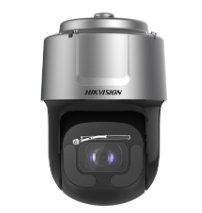
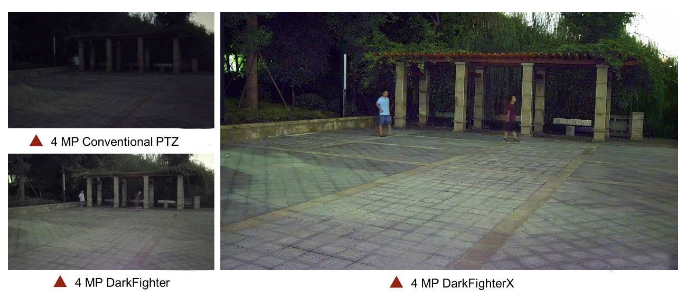
The new DarkFighterX camera employs 1/1.8” sensors to raise resolution to 4 megapixels.
-
This ‘beyond-HD’ image carries twice the amount of information as 2 MP models.
-
The camera can also deliver full colour images at light levels down to 0.0005 Lux.
-
This also means that, in the future, facial recognition could be possible, even in dim light, thanks to powerful imaging ability and beyond-HD resolution.
-
The camera has been equipped with an auto wiper to guarantee a better image on rainy days. This function is secured by a rain-detecting sensor on the head of the surface.
Other features include:
- 120 dB WDR, 3D DNR, Chromatic Defog
- Supports H.265+/H.265 video compression
- Rapid focus
- Up to 250m IR distance with Smart IR
- IP67
2. ANPR/LPR Cameras
- ANPR and LPR cameras are used to read and store data on registration plates.
- They offer a simple and efficient solution to many organisations including tolling, hotel overstay management and the obvious: car parking.
- ANPR stands for Automatic Number Plate Recognition (LPR cameras stands for License plate cameras) and these devices help to obtain copious information in a high traffic area to keep any premises secure.
- Other benefits of ANPR/LPR cameras include:
- Smart features: information storage
- Can identify cars that have been banned from a premises.
- Allows a business to run smoothly.
- For example:
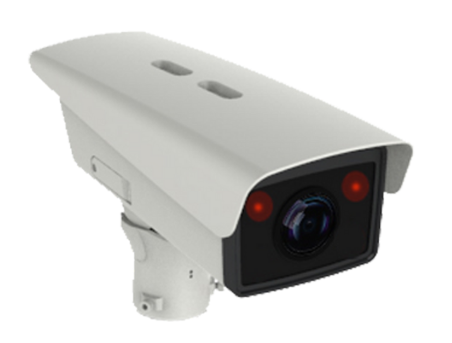
Features:
- 4MP ANPR Intelligent Entrance Video Unit
- 1/3'' Progressive Scan CMOS Up to 2688 × 1520 resolution with real- time video
- 2x pics high-performance LEDs (integrated white light and IR) 3.1 to 6mm motorized vari-focal lens
- Support relay output to control vehicle barrier, Support loop triggering or radar triggering, Support multi-frame LPR,
- Support dirty license plate recognition, Support quick pass of multiple vehicles, Support vehicle type,
- vehicle colour and vehicle brand recognition, Integrated shield, lights, TF Card (up to 128 G)
- Up to 30,000 whitelists, Offline control, PoE (802.3af), One-touch focus
3. Internal and External Dome Cameras
- The dome camera is one most commonly used for indoor and outdoor security and surveillance.
- The shape of the camera makes it difficult for onlookers to tell which way the camera is facing, which is a strong piece of design, deterring criminals by creating an air of
uncertainty. - Other benefits of internal and external dome cameras include:
- Ease of installation
- Vandal-resistant features
- IR night vision
- For Example:
-
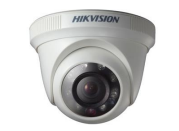
- Hikvision DS-2CE55A2P(N)-IRP is a true day/night indoor IR dome camera with 700 TVL horizontal resolution.
- It features 2.8 / 3.6 / 6 mm fixed lens, 20 m IR Distance & wide operating temperature range. It also has IR cut filter with auto switch.
4. Bullet Camera
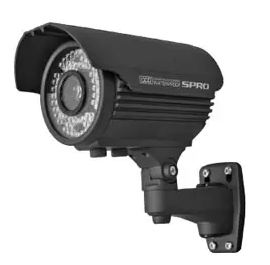
- Bullet cameras are long and cylindrical in shape and are ideal for outdoor use.
- Their strengths lie specifically in applications which require long distance viewing.
- Installed within protective casings, the cameras are shielded against dust, dirt, and other natural elements.
- The cameras can easily be mounted with a mounting bracket, and come fitted with either fixed or varifocal lenses depending on the requirements of its intended application.
- Other benefits of bullet cameras include:
- IR night vision
- Compact size aids installation
- High-quality image resolution
5. C-mount Camera
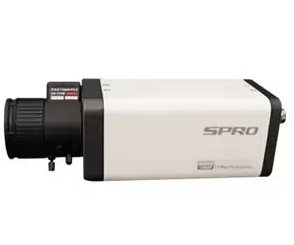
- Coming with detachable lenses, C-mount cameras allow for simple lens changes to fit different applications.
- C-mount cameras can cover distances beyond 40 ft thanks to the possibility to use special lenses with these cameras, whereas standard CCTV lenses can only cover distances of 35-40 ft.
- Other benefits of C-mount cameras include:
- Can support changes in technology.
- Effective for indoor use
- Bulky size makes them noticeable (which acts as a deterrent)
6. Day/Night Camera
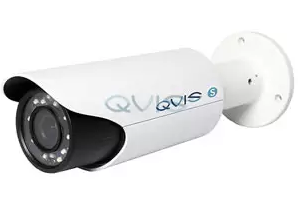
- Capable of operating in both normal and poorly lit environments, these cameras benefit from not requiring inbuilt infrared illuminators as they can capture clear video images in the dark thanks to their extra sensitive imaging chips.
- For this reason, these cameras are ideal for outdoor surveillance applications in which IR cameras are unable to function optimally.
- Other benefits of day/night cameras include:
- Record in both colour and black & white.
- Wide variety of sizes available
- Infrared capability
7. PTZ Pan Tilt & Zoom Camera
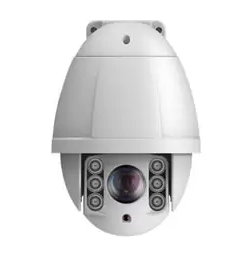
- PTZ – Pan/tilt/zoom – cameras allow the camera to be moved left or right (panning), up and down (tilting) and even allow the lens to be zoomed closer or farther.
- These cameras are used in situations where a live guard or surveillance specialist is there operating the security systems.
- Other benefits of PTZ cameras include:
- 200m IR night vision
- X36 optical zoom
- High-quality image resolution
8. Discreet CCTV
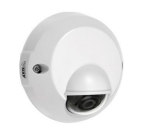
- These types of cameras allow for discreet placement which means you can capture good footage of theft and criminal damage.
- Discreet CCTV cameras beneficial because criminals will be less likely to spot them and therefore, they are less likely to be damaged in the process.
- Other benefits of discreet CCTV cameras include:
- Can be propped up or mounted.
- Can be disguised in various objects.
- Effective for indoor use.
9. Thermal Image Cameras/Infrared Cameras
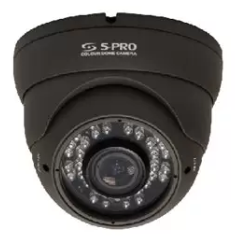
- One of the best 24-hour surveillance cameras around providing airports, seaports, boards and many other critical infrastructures with quality images, no matter what time of day it is.
- Infrared cameras have small LEDs surrounding the lens to help pick up moving figures in pitch black.
- Thermal image cameras can see over long distances, up to 300 metres away!
- Other benefits of infrared cameras include:
- Detect intruders up 250-300 metres away.
- Good in low-light
- Thermal radiation passes through visual barriers.
10. Varifocal Cameras
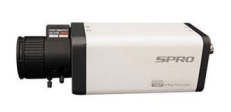
- With the ability to zoom in and out without forfeiting its focus.
- Varifocal cameras allow you to adjust the focal length, the angle and increase or decrease the zoom – ideal for obtaining footage in a square room where you would normally experience a ‘dead zone’ with any alternative, fixed lense camera.
- Other benefits of varifocal cameras include:
- Can capture those ‘dead zones’ that other cameras can’t.
- Offer exceptional focus.
- Work well up close and at long distances.
11. Network Cameras
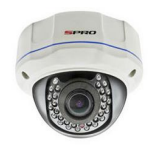
- These cameras share the images across the internet, so CCTV footage can be easily accessed.
- Network cameras are ideal for both domestic and commercial purposes because you can see what’s going on whilst away from the property.
- Other benefits of network cameras include:
- Data can be easily accessed.
- Ideal for homes and companies
- Less cabling and less maintenance
12. High-Definition Cameras
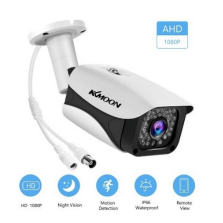
- High-definition cameras have such a high resolution that they’re mainly used in high-risk establishments such as banks and casinos.
- This is to capture a good image of anyone who enters and exits to maintain high security and maximum safety.
- These cameras are great for spotting misconduct and allows the user to zoom in for extra clarity, should the footage need to be used in court.
- Other benefits of high-definition cameras include:
- Clear, detailed pictures
- Offer maximum safety for high-risk establishments.
- Can zoom in without losing focus.